

Disclaimer: This article is for informational purposes only. We strongly recommend speaking with a qualified senior property advisor before making any final investment decisions.
Key Takeaways
- Building your own Bali villa gives you full control over the design, layout, materials, and long-term comfort.
- Buying a ready-to-live leasehold villa is usually faster, simpler, and less stressful for foreign retirees.
- If your goal is to save more and spend less upfront, a leasehold villa in a non-prime or semi-prime area is often the better choice.
- If your goal is to live in your exact dream retirement home, building may be worth considering with the right legal, architecture, and construction team.
- Before making any decision, always check the legal structure, property condition, zoning, renewal terms, and total long-term costs.
Many foreigners dream of retiring in Bali for its lower cost of living and slower pace of life. But villa prices here can still be costly. That’s why many are torn between building or buying a villa as a more cost-effective option.
This is an important decision because your retirement savings are not something you want to risk. However, the right choice always depends on your budget, timeline, and how much stress you are willing to handle.
If you are still comparing both options, here is what you should know (including a deep case study example).

Building Your Own Villa in Bali for Retirement
Building a villa from scratch can be a great choice if you have a very specific idea of your retirement home. Maybe you want a single-level villa with no stairs, wider doors, non-slip floors, better ventilation, or a layout that feels more comfortable for long-term living.
The biggest benefit of building a villa is control. You can design the home around your lifestyle, your health needs, and your future plans.
You can also choose the best materials, check the quality of the plumbing and electrical work, and make sure the structure is built properly from the beginning.
In the long run, building can also be more cost-efficient, especially if you plan to stay for 25 to 30 years. Instead of paying a premium for a finished luxury villa, you are creating the property based on your own budget and priorities.
Best for: If you want full design control, have enough time before your retirement days.
Pros:
- Full control over the villa design and layout
- Easier to create a retirement-friendly home with no stairs, wider doors, and safer flooring
- Better control over material quality, structure, plumbing, and electrical systems
- More flexible for long-term lifestyle needs
- Can be more cost-efficient if you plan to stay for 25–30 years
Cons:
- Longer process, often taking 12–24 months including design, permits, and construction
- More legal steps, especially around land lease, zoning, and building permits
- Higher risk of construction delays, rising costs, or poor workmanship
- Requires trusted professionals to avoid contractor problems
- Can be stressful for retirees who want a simple and peaceful move to Bali
Read More: How to Build Your Own Villa in Bali as Foreigners
Buy a Leasehold Bali Villa for Retirement
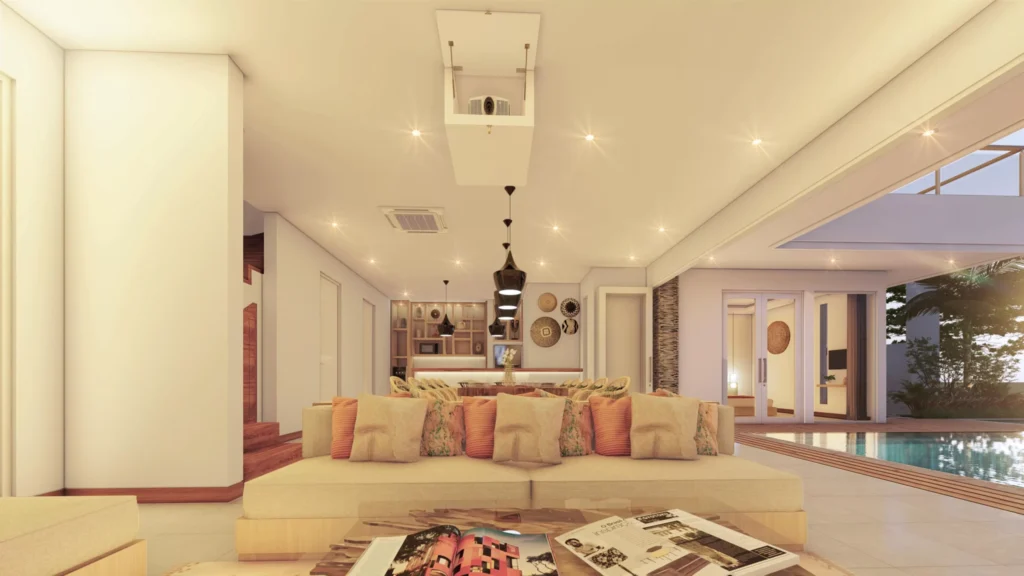
Buying a fully furnished retirement villa is often the easier choice. It is simple, faster, and less stressful. Once the leasehold agreement is checked and signed through a notary, you can move in and start enjoying your retirement in Bali much sooner.
You do not need to wait for construction or deal with permits. Another benefit is that you can see the real condition of the property before making a decision.
You can check the building quality, airflow, natural light, neighborhood noise, road access, and overall comfort. This is very useful because some issues only become clear when you visit the villa in person.
Best for: If you want faster, easier, and lower-stress way to live in Bali
Pros:
- Ready to move in much faster
- Easier and simpler process compared to building
- You can inspect the villa, neighborhood, road access, airflow, and noise before committing
- Less responsibility for permits and construction issues
- Better for retirees moving from abroad who want a smooth transition
Cons:
- Limited control over the villa design and layout
- Some villas may not be ideal for retirees, especially if they have stairs, open bathrooms, or open living areas
- Hidden issues may appear after moving in, such as leaks, poor drainage, or weak electrical systems
- Renovation options may be limited depending on the lease agreement
- Long-term lease terms, maintenance responsibility, and renewal clauses must be checked carefully
Which Option Is Better for Your Retirement Days in Bali?
The best choice depends on your priorities. If you want instant comfort, rent. If you want full control and seek a lower cost for owning a property in Bali, build.
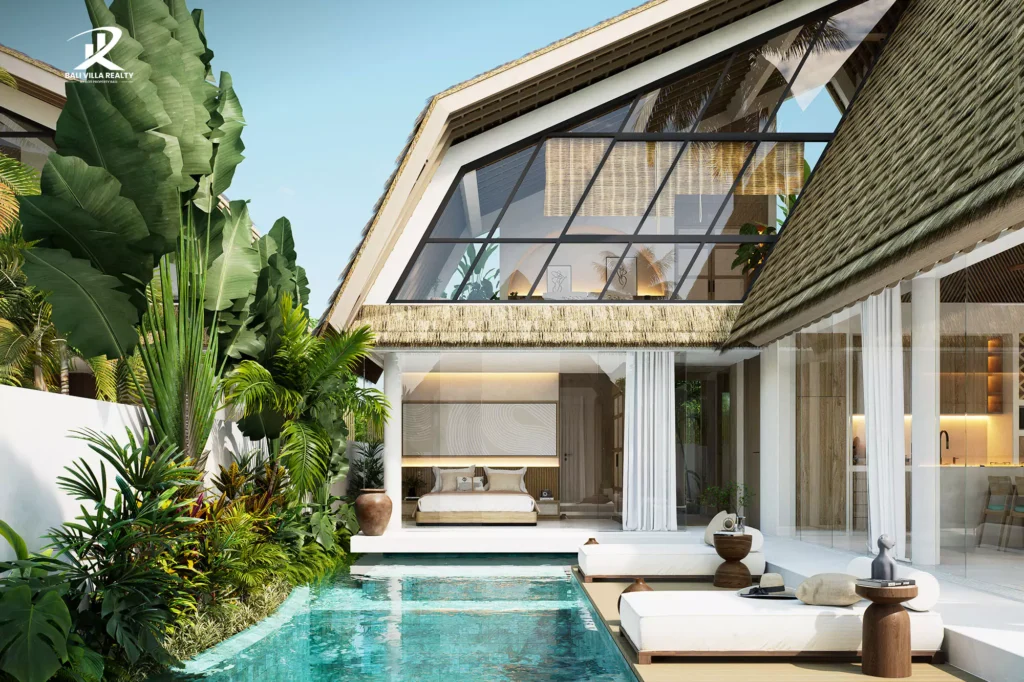
With over 20 years of experience helping expats create their homes in Bali, here’s what we do best:
- Design a villa that matches your style, personality, and vision
- Guide you through the entire building process, from start to finish
- Manage your villa long-term to maximize quality and returns
Case Study Example: An Australian Couple Planning Their Retirement in Bali

Australians are one of the largest expat groups in Bali. With Australia’s high living costs, especially property prices, many are now considering Bali as a more affordable place to retire.
Take Margaret and David, both 62, from Perth. After around 35 years of working—Margaret in nursing and David in construction—they are planning to retire in Bali for a more comfortable and cost-efficient lifestyle.
Their combined retirement income is AUD 10,956 per month from superannuation, equal to around IDR ±140.2 million per month (based on the exchange rate on June 9, 2026: 1 AUD ≈ IDR 12,800—which will be used in this case study calculation).
Now the big question is: which option helps them protect their savings better: building their own villa on leasehold land, or buying a turnkey leasehold villa? Here’s the breakdown.
Option A: Building Their Own Villa
For a comfortable but simple retirement villa, a mid-range build at around IDR 8–10 million/m² is the most realistic option.
With an ideal size of 120–200 m², the estimated construction cost (excluding anything outside the building itself) would look like this:
| Size | IDR 8 million/m² | IDR 10 million/m² | IDR 12 million/m² |
| 120 m² | IDR 960 million | IDR 1.2 billion | IDR 1.44 billion |
| 150 m² | IDR 1.2 billion | IDR 1.5 billion | IDR 1.8 billion |
| 200 m² | IDR 1.6 billion | IDR 2.0 billion | IDR 2.4 billion |
Additional costs may include:
| Component | Estimated Cost |
| Swimming pool, standard 4×8 m size | IDR 150–400 million |
| Furniture & fittings, mid-range | IDR 200–350 million |
| Land lease, 25-year leasehold | IDR 300 million–1 billion+, depending heavily on location |
| Building permits, PBG/SLF & notary | IDR 50–150 million |
| Landscaping & garden | IDR 50–150 million |
| Contingency / buffer, 15–20% | 15–20% of total construction cost |
Now, if Margaret and David want to build a 150 m² mid-range villa with a swimming pool, fully furnished, in a quiet retirement-friendly area, their estimated spending would be:
| Component | Estimate |
| Construction, 150 m² × IDR 10 million | IDR 1.5 billion |
| Swimming pool | IDR 200 million |
| Furniture & fittings | IDR 250 million |
| 25-year land lease, non-prime area | IDR 400–600 million |
| Permits, notary, legal | IDR 100 million |
| Landscaping | IDR 75 million |
| Buffer contingency, 15% | IDR 380 million |
| TOTAL | IDR 2.9–3.1 billion (≈ AUD 227,000 – 242,000) |
In other words, building the villa would cost them around 21–23 months (almost 2 years) of their retirement income.
Option B: Buying a Turnkey Villa (25-year Leasehold)
The leasehold system in Bali gives foreigners the right to use a property for a certain period of time, commonly 25–30 years, with an option to extend.
Now, let’s say David and Margaret are considering buying a simple 1-bedroom, fully furnished villa with a plunge pool under a 25-year leasehold in a quiet area. The typical villa pricing would look like this:
| Location Type | 25-Year Leasehold Price | Effective Cost per Year |
|---|---|---|
| Non-prime, such as outer Ubud, Tabanan, Klungkung | IDR 900 million – 1.2 billion / AUD 70,313 – 93,750 | IDR 36–48 million/year / AUD 2,813 – 3,750/year |
| Semi-prime, such as outer Canggu, Sanur, Jimbaran | IDR 1.2 billion – 1.8 billion / AUD 93,750 – 140,625 | IDR 48–72 million/year / AUD 3,750 – 5,625/year |
| Prime, such as Seminyak, central Canggu, Uluwatu view | IDR 1.8 billion – 3 billion+ / AUD 140,625 – 234,375+ | IDR 72–120 million+/year / AUD 5,625 – 9,375+/year |
There are also extra costs to prepare, such as:
- Notary & Legal Review Fee: IDR 20–50 million / AUD 1,563 – 3,906, one time
- Annual Maintenance Fee: IDR 12–24 million/year / AUD 938 – 1,875/year for pool, garden, and general upkeep
- Electricity & Water: IDR 6–12 million/year / AUD 469 – 938/year using a token system
Over 25 years, the notary, maintenance, electricity, and water costs can add up to around IDR 470–950 million / AUD 36,719–74,219.
In total, a 25-year leasehold villa would equal roughly 10–28 months of David and Margaret’s retirement income, depending on the villa location and total ongoing costs.
So, Which Option is Better?
If David and Margaret want to save more and spend less during retirement, buying a ready-to-live leasehold villa is the better option. The reason is simple: the upfront cost is much lower.
A 25-year leasehold villa in a non-prime or semi-prime area would cost around 10–20 months of their retirement income, while building their own villa could take up almost 2 years of their income.
However, if their goal is to live in their exact dream home, then building may be the better choice. It gives them more control over the layout, design, materials, and long-term comfort of the property.
Other Expenses to Consider When Retiring in Bali
Besides villa construction or leasehold costs, there are several other monthly expenses to consider if you want to retire in Bali:
| Category | Comfortable Living |
| Food & Dining | IDR 5-8M / AUD 460-770 |
| Transport | IDR 1.5M-3M / AUD 140 – 285 |
| Health Insurance | IDR 3-5M / AUD 285-475 |
| Local Staff | IDR 3.5M-5M / AUD 330-475 |
| Leisure & Misc | IDR 2-4M / AUD 190-385 |
| Monthly Total | IDR 30-50M / AUD 2,800-4,600 |
Going back to David and Margaret’s example, their combined retirement income of AUD 10,956/month (~IDR 140.2 million/month) gives them very strong buying power in Bali.
After covering regular living expenses, they could still have a monthly surplus of around IDR 90–110 million.
In general, IDR 30 million per month can already support a comfortable mid-to-luxury lifestyle for expats in Bali. To understand the bigger picture, you can also read our guide on the cost of living in Bali for expats.
Dreaming of Retiring in Bali? Let’s Make It Happen
Owning a retirement property in Bali has never been easier — especially with a professional team like iLot Property Bali guiding the way.
If you dream of a villa tailored to your retirement lifestyle, iLot Architecture can craft a home that is welcoming, practical, and built for lasting comfort. Imagine single-level living, breezy spaces, safe flooring, and rooms designed just for you…
And when your design is complete, iLot Construction brings your vision to life with a smooth building process, reliable oversight, and a focus on quality.
Schedule your free consultation and share your vision with us. Let us handle the details so you can relax and look forward to your new home. No commitment required.
With over 20 years of experience helping expats create their homes in Bali, here’s what we do best:
- Design a villa that matches your style, personality, and vision
- Guide you through the entire building process, from start to finish
- Manage your villa long-term to maximize quality and returns
Conclusion
Choosing between building or buying a villa for retirement in Bali depends on what matters most to you.
If you want a faster move, lower upfront cost, and less stress, buying a leasehold villa is usually the more practical choice. But if you want a home that is fully designed around your lifestyle, building can be the better path.
Before deciding, feel free to speak with our property advisor (no commitment required), so your retirement plan in Bali feels safe, clear, and stress-free.
FAQ
Yes. If you stay in Indonesia for more than 180 days in a year, you’re considered a tax resident. For KITAS holders, tax residency starts from the day the visa is issued. Income tax rates range from 5% to 35%, and you’ll need a local tax number (NPWP) to open a bank account.
The best places to retire in Bali depend on your lifestyle:
– Sanur is great for walkable beachfront living with good access to medical care
– Ubud offers culture and lush greenery
– Nusa Dua provides a more luxurious and peaceful setting
– Lovina is ideal for budget-friendly oceanfront living on Bali’s quieter north coast
Both are great options. Bali offers a relaxed island lifestyle, villa living, and strong expat communities. Thailand is generally cheaper with excellent healthcare and more city choices.