
Disclaimer: This article is part of our Guide to Building a Villa in Bali and for informational purposes only. We strongly recommend speaking with a qualified senior property advisor before making any final decisions.
Key Takeaways
- Land due diligence in Bali helps verify legal status, zoning, access, ownership, and hidden risks before purchase.
- The land due diligence process usually takes 2 to 4 weeks for standard plots, but complex cases involving PT PMA structures or coastal and forest zoning may take 4 to 8 weeks.
- Essential land due diligence checklist:
- Zoning and permitted land use
- Land certificate and ownership status
- Legal issues or encumbrances
- Road access and right-of-way
- Land boundaries and survey
- Utilities and infrastructure
- Taxes and outstanding payments
- Environmental and soil condition
- Local community and Desa Adat considerations
- Professional legal review
Before you can build a property in Bali, you need to secure the right plot of land. And before purchasing any land, you need to conduct proper land due diligence.
The land due diligence process is not exactly the same as villa due diligence, although the purpose is similar: to verify the land’s legality and identify any hidden risks before you commit.
By making sure your selected land can legally support your intended project, you reduce the risk of future disputes, permit issues, or development delays.
To help you understand the process, this guide outlines the essential land due diligence checklist and estimated timeline used by our legal consultants at iLot Property Bali.

1. Verify Zoning and Spatial Planning Regulations
In Bali, land use is governed by regional spatial planning regulations known as RDTR (Rencana Detail Tata Ruang), or Detailed Spatial Plans. These regulations determine how land may legally be used and developed.
There are six main categories of Bali land zoning, including:
- Green zone: agricultural
- Pink zone: tourism
- Red zone: business
- Yellow zone: residential
- Orange zone: mixed-use
- Conservation zone
You must ensure that your selected land is located within the correct zoning category for your intended use. It is also important to confirm that the planned development does not violate building boundary rules, setback lines, or other spatial planning requirements.
A villa built on land with improper zoning may struggle to obtain the right permits. In serious cases, the building may even be subject to enforcement action or demolition, like what happened in Bingin Beach (2025).
2. Verify Land Certificate and Ownership Status
Verifying the land certificate is one of the most important parts of legal due diligence. This process usually involves several checks through the ATR/BPN land office.
The review includes:
- Checking the certificate number and confirming its authenticity.
- Ensuring the SHM (Surat Hak Milik) matches the official Land Book stored at the National Land Agency, or BPN.
- Confirming the land is not categorized as abandoned land, which may carry the risk of being reclaimed by the state.
- Making sure the land is not blocked due to inheritance disputes, legal seizure, court issues, or other legal problems.
- Confirming the land is not being used as collateral with a bank or third party under Hak Tanggungan.
- Verifying the owner’s identity, such as ID card, family card, and land deed if the land is part of joint marital property.
- Confirming that the seller is the legal owner and has the authority to complete the transaction.
- Checking the property tax status, including PBB payments.
- Reviewing other important details such as land size, land boundaries, historical ownership records, and legal restrictions that may affect transferability.
Common land certificate types in Bali include:
- SHM — Surat Hak Milik / Freehold: This is the strongest form of ownership and is typically held by Indonesian individuals.
- HGB — Hak Guna Bangunan: This is the right to build on land and is commonly held by companies, including PT PMA structures.
- Hak Pakai — Right of Use: This is a right-of-use title that may be available to foreign individuals under specific conditions.
Once the legal team confirms that the seller has the legal authority to sell the land, the ownership rights are properly registered, and there are no hidden claims or legal issues, the land can be considered safer to purchase and use.
Read More: Can You Build on Leasehold Land in Bali?
3. Confirm Physical Access and Road Connectivity

A beautiful plot of land is not enough if it is difficult to access. This is especially important in Bali, where roads can be narrow, winding, steep, or located behind rice fields and private properties.
Access issues are a common cause of disputes in Bali property transactions. Sometimes a project is delayed or blocked because the land lacks proper road access. Furthermore, a bad location directly affects long-term usability, guest comfort, and your property’s market value.
Key items to review include:
- Whether the land is directly connected to a public road.
- Whether access depends on neighboring properties.
- Whether a right-of-way agreement exists.
- Whether access rights are legally documented.
- Whether the road is suitable for construction vehicles and future property operations.
4. Investigate Easements, Servitudes, and Third-Party Rights
Not all land can be used exclusively by its owner. Some properties may be subject to servitudes, easements, or third-party usage rights that can affect future development.
Examples include:
- Shared road access
- Irrigation channels
- Utility corridors
- Drainage systems
- Traditional village pathways
- Neighboring access rights
Similar to zoning issues, violating shared facilities or protected access areas can create serious problems for your villa development.
One example is the villa development in Umalas Tunon, North Kuta (Villa Pandawa Sweet), which recently went viral because it is said to have violated rules on how close buildings can be to the river. The development is thought to have exceeded the permitted limit and reduced the area of the nearby river. Authorities have responded directly.
Read More: How Much Land Do You Need to Build a Villa in Bali?
5. Conduct Environmental and Soil Assessments

Environmental and soil assessments help confirm whether the land is safe and suitable for its intended purpose. Experts can test if the soil is good for building, farming, or other projects. They also check for drainage and erosion problems that could harm the land over time.
Environmental studies can also identify potential problems such as pollution, flooding, poor soil, drainage issues, or erosion. Skipping these checks might cause problems later, increase building costs, or limit how the land can be used.
Read More: How to Choose the Right Bali Villa Builder: Best Practice
6. Assess Utility Access and Infrastructure Availability
A piece of land might catch your eye with its beauty, yet hide a lack of essential infrastructure beneath the surface. That is why it is crucial to investigate utility access and infrastructure availability before purchasing land in Bali.
Important infrastructure and utilities to check include:
- Electricity
- Water supply
- Waste management
- Internet connection
- Road infrastructure
- Drainage access
Some key questions to ask in this case:
- Are utility connections already available?
- How far is the nearest electricity connection point?
- Will new infrastructure need to be installed?
- What are the estimated connection costs in that area?
- Is there reliable road infrastructure for construction and future operations?
- Is water access available and legally usable?
7. Review Surveys and Boundary Maps
Confusion about land boundaries is common and can lead to arguments with neighbors. That’s why you need updated surveys to determine the property’s exact boundaries, size, and usable land.
A proper survey verifies that the land being sold is what the seller says it is. Boundary maps also show important details about shared access, paths, water flow, or other limits that might affect how the land can be used later.
8. Review Property Taxes and Financial Obligations
Reviewing financial obligations is also an important part of land due diligence. Before buying land in Bali, you should check the property tax records, outstanding payments, transfer costs, notary fees, and any possible financing or mortgage arrangements.
You should also consider future costs, such as utility connections or new infrastructure. Understanding these expenses early helps you plan your budget properly and avoid unexpected costs after the purchase.
9. Evaluate Local Community and Market Considerations
The final step is to understand the local community and surroundings of the land you want to buy. This includes checking the relationship with the local village, Desa Adat rules, traditional land use, community plans, and any possible social concerns.
This is important because your projects can face delays or objections if they are seen as disruptive, damaging, or disrespectful to local customs. You should also check whether the area has strong market demand, especially if you plan to use the land for commercial investment.
Final Land Due Diligence Checklist
| Checklist Item | What to Check |
|---|---|
| Zoning and permitted land use | Confirm the land can legally be used for your intended project, such as a villa, residence, or commercial property. |
| Land certificate and ownership status | Verify the certificate through BPN and make sure the seller is the legal owner with the right to sell. |
| Legal issues or encumbrances | Check that the land is not under dispute, blocked, used as collateral, or affected by hidden claims. |
| Road access and right-of-way | Make sure the land has legal and usable access, especially for construction vehicles and future property use. |
| Land boundaries and survey | Confirm the exact land size, boundaries, and usable area through an updated survey. |
| Utilities and infrastructure | Check the availability of electricity, water, drainage, internet, road access, and possible connection costs. |
| Taxes and outstanding payments | Review PBB property tax records, unpaid liabilities, transfer costs, notary fees, and other financial obligations. |
| Environmental and soil condition | Check soil quality, drainage, erosion, flooding risk, and whether the land is suitable for construction. |
| Local community and Desa Adat considerations | Understand local rules, village expectations, and potential community concerns before starting development. |
| Professional legal review | Have a notary, legal consultant, or property advisor review everything before signing or making payment. |

With over 20 years of experience helping expats create their homes in Bali, here’s what we do best:
- Design a villa that matches your style, personality, and vision
- Guide you through the entire building process, from start to finish
- Manage your villa long-term to maximize quality and returns
Timeline for Land Due Diligence in Bali
The land due diligence process in Bali typically takes 2 to 4 weeks, or around 14 to 30 days, for standard plots.
If the transaction involves setting up a foreign-owned company, such as a PT PMA, or dealing with complex coastal or forest zoning, the timeline can extend to 4 to 8 weeks.
A general timeline may look like this:
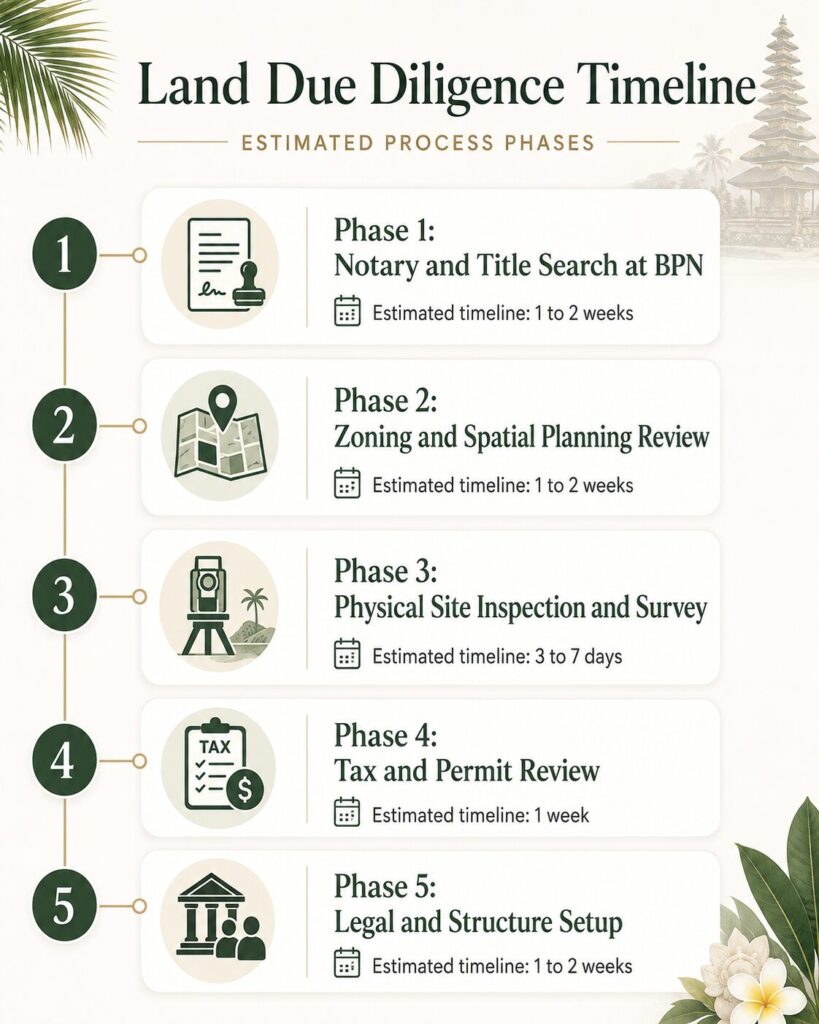
The actual timeline may vary depending on the land condition, location, ownership structure, documentation, zoning complexity, and the responsiveness of the relevant authorities.
How Much Is Due Diligence Cost?
Land due diligence costs usually range from $500 to $5,000 USD (approximately IDR 8.9 million to IDR 89 million; using currency 1 USD = IDR 17.953) depending on the land size and complexity.
However, the exact cost range may vary. It is best to consult the relevant parties directly to get an accurate estimate.
Read More: How Much Does It Cost to Build a Villa in Bali per Square Meter?
Need Help With Land Due Diligence in Bali?
Land due diligence can be challenging, especially for foreign investors unfamiliar with Bali’s legal, zoning, and community systems. That’s why many foreign investors work with a Bali real estate agency that provides due diligence services like iLot Property Bali.
iLot Property Bali provides end-to-end support for land buyers, from legal checks and site review to architecture, construction, and property management. Our team helps you understand what to check, what to avoid, and how to move forward with confidence.
Book a free, no-commitment consultation to discuss your land and project plan now.

Conclusion
Land due diligence checks the legal, physical, financial, and regulatory aspects of a property before purchase. In Bali, the process usually takes 2 to 4 weeks for standard plots and up to 4 to 8 weeks for more complex cases.
Now you can simplify the due diligence process with professional support from iLot Property Bali.
We provide end-to-end services for your property investment, including legal checks, consultant review, architecture, property construction, and villa management.
Get started by booking a free consultation today. No commitment required.
FAQ
It helps people and companies make smarter choices by digging into and reviewing the details of a possible deal or investment.
The buyer pays for due diligence.
Once the due diligence period ends, buyers usually cannot cancel the deal without losing their deposit unless there are still valid conditions, such as financing. If both sides agree, the due diligence period can be extended.