

Disclaimer: This article is for informational purposes only. Indonesian regulations may change over time. Always confirm the latest requirements with a qualified Indonesian legal advisor before establishing or investing in a business in Bali.
Key Takeaways
- Foreigners can start and own businesses in Bali, usually through a PT PMA, as long as the chosen business activity and KBLI classification are open to foreign investment.
- Bali currently restricts foreign investors from obtaining new OSS permits for 18 categories of low- and medium-low-risk businesses.
- A PT PMA generally requires more than IDR 10 billion in investment value per business field and project location, while the minimum paid-up capital is generally IDR 2.5 billion, subject to applicable rules and exceptions.
- Foreign founders also need to consider licensing, NIB, zoning, permits, taxation, immigration status, and ongoing reporting and compliance before operating.
Yes, foreigners can start and own a business in Bali. But what you can open, how you set it up, and how much capital you may need depend on the business activity and Indonesia’s foreign investment rules.
The range of permitted business activities is relatively broad, covering sectors such as hospitality, wellness, real estate, food and beverage, and more—all through PT PMA (Perseroan Terbatas Penanaman Modal Asing), Indonesia’s foreign-owned limited liability company.
Setting up a business in Bali involves more than choosing a promising location and registering a company. This guide breaks down how to start a business in Bali as a foreigner, the estimated costs involved, and the key things to check before committing your capital.
What Businesses Can and Cannot Foreign Investors Own in Bali?
Bali Governor Wayan Koster has said that foreign investors can no longer access Indonesia’s online licensing system for 18 categories of low- and medium-low-risk businesses:
- Small-scale star-rated hotels (with a building area below 6,000 m²)
- Non-star-rated hotels, also known as budget or “melati” hotels
- Other accommodation services: homestays, guesthouses, and hostels
- Owned or leased real estate (including certain types or scales of property agencies and property services)
- Bars and cafés
- Vehicle rentals: cars, buses, and trucks
- Motorcycle rentals
- Clothing and textile retail
- Food retail
- Mobile agricultural and food retail
- Traditional medicine shops
- Gyms / fitness centers
- Stadium facilities
- Tailoring services
- Sports activity promotion
- Management consulting / industrial management consulting
Some salon, spa, and wellness businesses listed under low-risk KBLI codes (Indonesia’s standard classification system for business activities) may also be affected by these stricter rules. Medium- and high-risk businesses are not included in this restriction.
Since May 2026, foreigners have not been able to apply for new permits through the OSS system for these business categories. This will remain in place until new regulations are issued.
The governor explained that some foreign investors were using low-risk business categories to avoid higher capital investment requirements. These categories only require a Business Identification Number (NIB), making the licensing process considerably simpler.
Read More: 9 Best Business Opportunities in Bali for Expats (2026)
How Can Foreigners Legally Start a Business in Bali?

A PT PMA is the usual structure for foreign investors who want to start a business in Bali. It is an Indonesian limited liability company that allows foreign individuals or companies to own shares in an Indonesian business.
The company usually needs at least two shareholders, who can be people or legal entities. These shareholders do not have to include an Indonesian citizen. If the business activity allows 100% foreign ownership, foreign investors can hold all shares.
How Much Capital Do You Need to Start a PT PMA?
Many people confuse investment value with paid-up capital when starting a foreign-owned business in Indonesia. These two things are not always the same:
- Minimum investment value: more than IDR 10 billion (approx. $558,909) per business field and project location, generally excluding land and buildings, subject to applicable rules and exceptions. Tech-based startups operating in Special Economic Zones (SEZs) are exempt from this limit.
- Minimum paid-up capital: generally IDR 2.5 billion (approx. $139,727) for a PT PMA, according to BKPM Regulation No. 5 of 2025.
So, putting IDR 2.5 billion into your company does not always mean you have met the full investment requirement. The exact amount depends on your business activity, project, KBLI classification, and applicable rules.
Read More: 7 Smart Property Investment Strategies to Make Money in Bali
What to Do Before Starting a Business in Bali
Setting up the legal side matters, but you should think carefully about your business idea first. Before you invest a lot, take time to understand how your business would really work in Bali.
1. Research the Bali Market
Bali’s business environment can be very different from what you know at home, especially if your business depends on tourism. That’s why it’s important to research things like:
- Your target customers
- Seasonality
- Costs (including local taxes)
- Infrastructure
- Supply chains
- Zoning and location restrictions
2. Understand the Local Business Environment
To run a business well in Bali as a foreigner, you need to learn how things work locally. The best way is to build relationships with Indonesian professionals, suppliers, employees, business owners, and local communities. Don’t rely only on advice from other expats.
Talking to people who already run businesses in Bali can give you useful tips you won’t find in the “written rules”. Still, always get professional advice before making big decisions.
3. Get Professional Advice Before Committing Capital
It’s a good idea to talk to an Indonesian legal consultant before you sign any big contracts. They can explain the legal requirements, tell you what’s allowed, and help you make better decisions.
If you need help, iLot Legal can guide you through the process. We offer free initial advice and full legal support for setting up your business, including due diligence, PT PMA setup, taxes, hiring, and more. Feel free to ask us anytime if you’d like to learn more.
How to Start a Business in Bali as a Foreigner
Indonesian law requires foreign investment companies to be set up as Limited Liability Companies (PTs). The process varies by business, but most foreign investors follow these steps and work with a licensed local notary.
1. Define Your Business Model
First, clarify what your company will do. Then, check whether foreign ownership is allowed and make sure your business structure matches the right KBLI codes.
Even if businesses seem similar to customers, they can have very different KBLI codes. For example, hospitality includes hotels, villas, spas, and wellness businesses.
Calling your company a “hospitality company” is usually not enough; the description type may require different approvals.
2. Prepare the PT PMA Requirements
To set up a PT PMA, you’ll need to prepare documents and information relating to the company, shareholders, and management, including directors and commissioners.
Company Documents include:
- A Power of Attorney signed by all shareholders, authorizing submission of company documents.
- Rental agreement between the company and the building or property management.
- Original domicile statement or confirmation letter issued by the building management.
- Current-year Building and Land Tax (PBB) receipt, including proof of payment.
- IMB (Building Permit) or proof of ownership if the company owns the premises.
- Lease statement, where applicable.
- At least three photos of the office showing the reception area, company signage, and workspace used for business activities.
- Verified domicile statement from the building management.
- Company letterhead and a sample of the official company stamp.
Shareholder Documents include:
- Copy of the Articles of Association, including any amendments, available in English or Bahasa Indonesia.
- Business registration certificate.
- Details of the company’s Board of Directors structure.
Personal Documents (Directors & Commissioners): Vary depending on nationality. Foreign nationals will need a color copy of their passport with at least 18 months of remaining validity and a minimum of four blank pages.
For Indonesian nationals, the required documents include:
- Indonesian ID card (KTP) and Taxpayer Identification Number.
- Family Card (KK).
- Indonesian visa stamp.
- Proof of residence, such as a hotel or apartment residence letter for the director.
- Recent passport-size photo with a red background for each member of the Board of Directors.
You also need to provide a real office address. Virtual addresses are not accepted for PT PMA registration at this time.
3. Establish the PT PMA
An Indonesian notary prepares the company’s deed of establishment and Articles of Association. After that, the company goes through the Ministry of Law registration and legalization process.
It helps to work with a notary who often handles foreign-investment companies, since PT PMA requirements can be different from those for a regular locally owned PT.
4. Obtain an NPWP
The company needs to get an Indonesian Taxpayer Identification Number, called an NPWP.
It’s also important to set up proper bookkeeping from the start, such as:
- Accounting procedures.
- Company banking.
- Payroll.
- Employee records.
- Invoices and receipts.
- Tax filing responsibilities.
- Company expenses.
- Shareholder transactions.
5. Register Through OSS and Obtain an NIB
Indonesia manages business licensing through the Online Single Submission (OSS) system (oss.go.id). Through OSS, businesses receive a Business Identification Number (NIB / Nomor Induk Berusaha), which serves as the company’s main business ID.
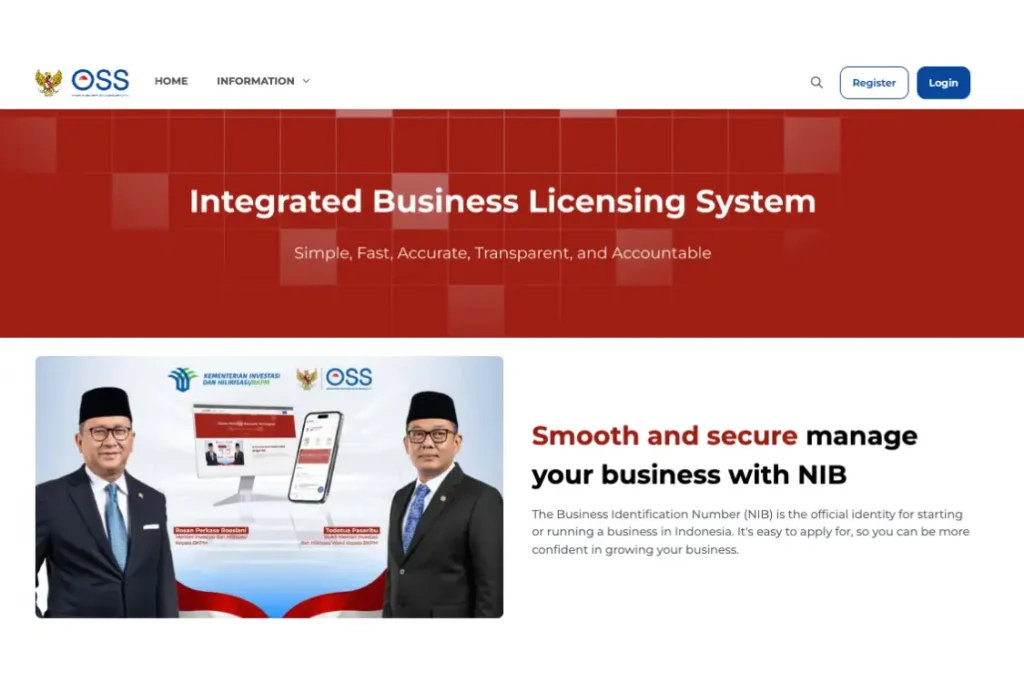
However, having an NIB does not automatically mean a business can start every registered activity. Depending on the type and risk level of the business, additional requirements may apply, such as spatial planning compliance, environmental approvals, building permits, Standard Certificates, or other licenses.
Under Indonesia’s risk-based licensing system, the basic requirements generally work like this:
- Low-risk business: NIB
- Medium-risk business: NIB + Standard Certificate
- High-risk business: NIB + required business license
Some businesses may also need additional permits or approvals to support their operations, depending on the specific activity.
6. Secure Suitable Business Premises
A nice-looking location is not enough. Before you sign a lease or start building a commercial property, check that the premises can legally support your business. You can do this by having a legal consultant or notary carry out due diligence.
This process usually involves checking zoning, allowed building use, PBG / SLF, and other permits, such as local operational or tourism permits. You should also review the property, its ownership, and contract documents to ensure everything complies with the rules.
Tax Obligations for Foreign-Owned Businesses
A PT PMA set up or based in Indonesia is usually treated as an Indonesian corporate tax resident. But foreign shareholders might also have tax duties in their own countries.
For this reason, international founders should consider both Indonesian taxes and their home-country tax situation, especially when handling dividends, salaries, shareholder loans, overseas payments, and foreign income.
Ongoing PT PMA Reporting and Compliance
Registering your company is just the beginning. A PT PMA must keep up with corporate, licensing, investment, employment, and tax rules. PT PMAs may also need to submit an LKPM (Investment Activity Report) through OSS, often every quarter, depending on the company’s stage and requirements.
A company may be legally set up but still face problems if it doesn’t keep its licenses, reports, taxes, or approvals up to date.
Read More: Protecting Your Bali Investment from Sudden Rule Changes: 3 Proven Ways
Conclusion
Foreigners can start a business in Bali, but the process begins with choosing the right business activity and legal structure, not just registering a PT PMA (foreign investment company).
Before you invest a lot of money, we suggest you consider these five key questions to help avoid legal issues:
- Is the proposed business activity open to foreign investment?
- Can the relevant KBLI be 100% foreign-owned?
- What investment, capital, and licensing requirements apply?
- Can the chosen property legally be used for the business?
- Does your immigration status allow you to perform your intended role?
Need help establishing your business in Bali the right way? Let’s talk (free, no obligation).
FAQ
No. A tourist or visitor visa does not give you permission to actively work in or manage a business in Bali. If you are a foreign shareholder, director, commissioner, or employee, your immigration status should match the role and activities you actually perform.
No. Establishing a PT PMA does not give foreign shareholders personal ownership of freehold land in Indonesia. Company ownership and land ownership are treated separately under Indonesian law, and Hak Milik (freehold) ownership is reserved for Indonesian citizens.
Not necessarily. Besides establishing a PT PMA directly, foreign investors may consider several business structures or operating models in Indonesia:
– PT PMA subsidiary: A foreign company can become a shareholder in an Indonesian PT PMA. This structure is commonly used when the Indonesian operation will generate local revenue, employ staff, enter into contracts, or hold operational assets.
– Representative office: Certain foreign companies may establish a representative office in Indonesia. However, representative offices come with restrictions and may not suit businesses that intend to conduct normal revenue-generating commercial activities.
– Cross-border service: A foreign company may provide services to Indonesian customers from overseas without necessarily establishing a full local operating company. However, you should still carefully consider issues such as permanent establishment, withholding tax, transfer pricing, licensing, and other tax obligations.
Potentially. However, running an online business does not automatically exempt you from Indonesian company, immigration, employment, or tax requirements.
If you manage or run your business from Indonesia, it’s a good idea to get professional advice to see if you need an Indonesian company, local tax registration, or the right immigration status.
The process is easier with the right business structure and professional support. Many foreign business owners work with an end-to-end partner like iLot Property Bali for help.
We can assist with legal matters and other requirements for setting up your business in Bali. Visit our service page or contact our team for advice tailored to your needs.